

Native Americans in the Southwest are vulnerable to climate change because of their intimate relationship with the environment upon which their culture, tradition, and livelihood depend. Climate change may overwhelm tribes already stressed by economical and development challenges. A primary example is Nevada’s largest tribe, the Pyramid Lake Paiute Tribe, located at the terminal end of the Truckee River Basin, who are deeply connected—culturally, physically, and spiritually—to Pyramid Lake and its ecosystem.
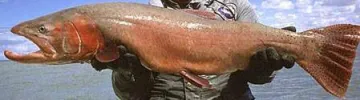
Pyramid Lake is home to the endangered cui-ui fish (Chasmistes cujus) and the threatened Lahontan cutthroat trout (Oncorhynchus clarki henshawi) shown above - two important cultural resources to the Pyramid Lake Paiute Tribe. Despite more than a century of upstream water diversions for agricultural and municipal purposes, the Pyramid Lake Paiute Tribe has been able to secure their tribal water rights and protect the Lake and its ecosystem.
Nevertheless, the Pyramid Lake Paiute Tribe, like other Southwest tribes, may be disproportionately impacted by flooding and droughts brought on by climate change (Redsteer et al. 2013) due to undeveloped or non-existent water management infrastructure. While climate change studies for the Truckee River Basin have been done, a climate change adaptation study that incorporates tribal perspectives is lacking. Researchers have found that conventional climate change adaptation planning may have unintended consequences for tribes and may lead to conflict if tribal consultation is not considered (Redsteer et al. 2013).
This project addresses the need for tribal climate change adaptation planning in the region, and the primary objectives are to:
- Determine the potential of the Pyramid Lake Paiute Tribe to adapt to climate change by understanding vulnerabilities, thresholds, and resiliencies of the systems
- Propose collaborative tribal water management and adaptive strategies for the Pyramid Lake Paiute Tribe
- Produce a framework for a decision support system model of a coupled climate-biophysical-social system
- Explore the potential for effective partnerships and collaborations between tribes and scientists
This research project is a collaborative effort between the Pyramid Lake Paiute Tribe, the University of Arizona, the University of Nevada Las Vegas, and the U.S. Geological Survey. Funding for this project comes from a two-year grant from the U.S. Geological Survey Southwest Climate Science Center (SWCSC). Full description of this project at the SWCSC website.
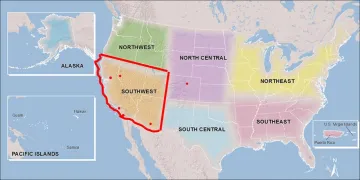
The image above shows a map of the eight Climate Science Center regions in the U.S. The Southwest Climate Science Center, outlined in red, is a consortium of six host institutions: University of Arizona; University of California, Davis; UCLA; Desert Research Institute, Reno; University of Colorado, Boulder; & Scripps Institution of Oceanography at the University of California, San Diego (doi.gov).
Previous Climate Change Vulnerability Study carried out at the Pyramid Lake Paiute Tribe
This research will build on the results from a previous analysis of the Pyramid Lake Paiute Tribe's vulnerability to climate change. This study was conducted by Drs. Mahesh Gautam, Karletta Chief, and William J. Smith, Jr. through a NSF Nevada EPSCOR seed grant. The results of this analysis were published in the journal Climatic Change in a special issue on "Climate Change and Indigenous Peoples in the United States: Impacts, Experiences, and Actions." The article can be downloaded.
The results of this study were also presented by Dr. Karletta Chief at the Second International Climate Change Adaptation Conference at the University of Arizona in 2012. Full video presentation.
Presentations
Presentations
In 2012, Dr. Karletta Chief presented at the American Indian Climate Change Working Group and at the University of Arizona Native Nations Water Rights Symposium. Here is a video recording of her presentation.
On June 26, 2013, Olin Anderson, Schuyler Chew, and Shannon Mandell gave a presentation on the project at the 2013 Mid-Year Conference of the National Congress of American Indians (NCAI) in Reno, NV. The presentation was given at the 8th Annual Tribal Leader / Scholar Forum on the panel "Agriculture, Timber, & Water: Sustaining our Natural Resources." A PDF document of the presentation slides is available below.
On September 17, 2013., Dr. Karletta Chief moderated a panel at the 12th Biennial Conference of Science and Management on the Colorado Plateau The title of the panel was "Climate change impacts on Native Americans on the Colorado Plateau: Cultural and natural resource considerations, assessment, data gaps, technology needs, and opportunities." Click here to go to the conference agenda and program.
On September 25th and 26th, 2013, Dr. Karletta Chief, Dr. Aleix Serrat Capdevila, and Schuyler Chew collaborated with the Pyramid Lake Paiute Tribe Environmental Department to hold a Climate Change Planning Workshop for PLPT tribal members in Nixon, NV.
From October 1st to 3rd, 2013, Schuyler Chew attended a course on Climate Change Adaptation Planning for Great Basin tribes at the Desert Research Institute. The course was hosted by the Institute for Tribal Environmental Professionals (ITEP) and the Pyramid Lake Paiute Tribe Environmental Department.
On November 7, 2013, Schuyler Chew gave a presentation at the 2013 Nevada Water Resources Association River Symposium which took place from November 6th to 7th in Reno, NV. More information on this event.
On December 9. 2013, Dr. David Busch gave a presentation at the 2013 Great Basin Consortium at the University of Nevada Reno.
On June 19, 2014, Dr. Karletta Chief gave a presentation at the 2014 University Council on Water Resources Conference which took place June 18th to 20th at Tufts, University in Medford, MA.
On Friday, August 15, 2014, members of the research team gave a public presentation at Wadsworth, NV and a presentation to the Pyramid Lake Paiute Tribal Council on some outcomes of the project.
On Tuesday, October 14, 2014, Dr. Karletta Chief and Schuyler Chew gave a presentation for the National Climate Change and Wildlife Science Center (NCCWSC) webinar series titled, "Climate Change Vulnerability of Native Americans in the Southwest: A Case Study of Tribal Climate Adaptation Among the Pyramid Lake Paiute Tribe".
Documents
Event Archive
Event Archive:
Links to Resources (more links):
- The results of a socioeconomic vulnerability analysis study carried out at the Pyramid Lake Paiute Tribe in 2009 were recently featured in the journal "Climatic Change". This article was part of a Special Issue on "Climate Change and Indigenous Peoples in the United States: Impacts, Experiences, and Actions" edited by Julie Koppel Maldonado, Rajul E. Pandya, and Benedict J. Colombi. The journal can be downloaded.
The results of this study were also presented by Dr. Karletta Chief at the Second International Climate Change Adaptation Conference at the University of Arizona in 2012. View the full video presentation.

- In a regionally-driven effort, the Southwest Climate Science Center recently partnered with the Climate Assessment for the Southwest (CLIMAS) and other researchers on a comprehensive report for the National Climate Assessment. The "Assessment of Climate Change in the Southwest United States" report went far beyond expectations and has been widely praised for its comprehensiveness. The entire report can be downloaded.
- Chapter 17 of the "Assessment of Climate Change in the Southwest United States" report focuses on climate change impacts to Native Americans in the Southwest. The entire chapter and a two-page fact sheet can be downloaded.
- In 2010, the Pyramid Lake Paiute Tribe collaborated with the Climate Change Native American Technical Group on a video featuring Nevada tribes and climate change. You can view the video here.
Videos
Project PI Dr. Karletta Chief presented this talk at the 2014 UCOWR/NIWR/CUAHSI Annual Conference "Water Systems, Science, and Society under Global Change" at Tufts University on June 19, 2014. This talk was part of the Massachusetts Water Resources Research Center's organized track on "Advancing agricultural security and resilience under nonstationarity and uncertainty: evolving roles of blue, green and grey water."
<iframe width="560" height="315" src="https://www.youtube.com/embed/Ln3OuuO6Pnw?si=GWYrGC61cB5zmEhQ" title="YouTube video player" frameborder="0" allow="accelerometer; autoplay; clipboard-write; encrypted-media; gyroscope; picture-in-picture; web-share" referrerpolicy="strict-origin-when-cross-origin" allowfullscreen></iframe>Here is a video we created as an educational resource on the spawning and habitat requirements of the cui-ui and Lahontan cutthroat trout.
<iframe width="560" height="315" src="https://www.youtube.com/embed/1sBAYBMeRFs?si=CrE5Bicy2YBV9R5H" title="YouTube video player" frameborder="0" allow="accelerometer; autoplay; clipboard-write; encrypted-media; gyroscope; picture-in-picture; web-share" referrerpolicy="strict-origin-when-cross-origin" allowfullscreen></iframe>
This research will build on the results from a previous analysis of the Pyramid Lake Paiute Tribe's vulnerability to climate change. The results of this study were presented by Dr. Karletta Chief at the Second International Climate Change Adaptation Conference at the University of Arizona in 2012. Click here for the full video presentation.
Another video presentation on the impacts of climate change to tribes in the Southwest by Dr. Margaret Hiza Redsteer is available here. Please watch from 29:22 to 45:28 for Dr. Redsteer's presentation.
Please feel free to explore this page and contact us with any questions or comments. Thank you for your interest in this research!