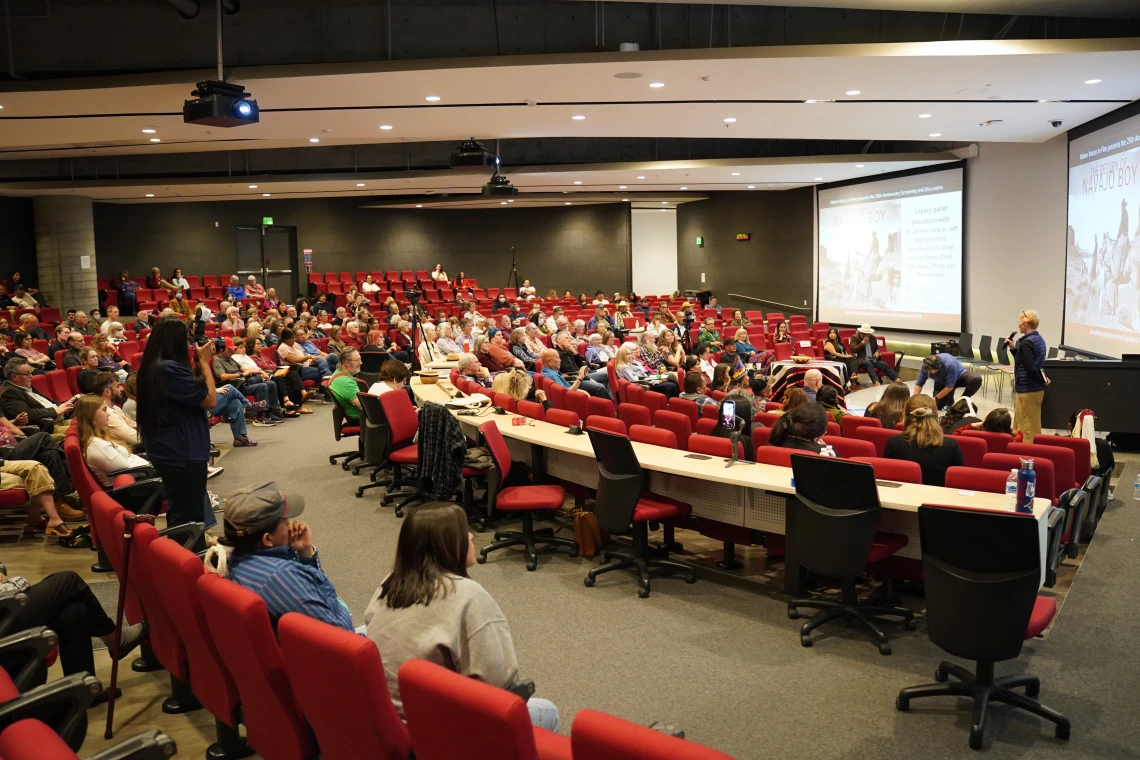
A Powerful Afternoon: Screening and Panel Discussion of The Return of Navajo Boy

On February 15th, the Indigenous Resilience Center co-hosted one of the most meaningful events of the semester. We screened The Return of Navajo Boy, an official selection of the Sundance Film Festival and PBS, in celebration of the film’s 25th anniversary. What followed the screening was an afternoon of honest, powerful conversation that we will not soon forget.
About the Film
Directed by Emmy Award-winning filmmaker Jeff Spitz, The Return of Navajo Boy tells the story of the Cly family of Monument Valley, whose lives are woven through decades of photographs and films they never had a voice in. When a long-lost silent film surfaces in 1997, it sets off a remarkable chain of events, including the rediscovery of John Wayne Cly, an infant who had been taken from his family by white missionaries in the 1950s and raised far from his Navajo home.
The film weaves together themes of family, identity, Native representation in Hollywood, off-reservation adoption, and the lasting effects of uranium mining on the Navajo Nation. It is an intimate and at times difficult watch, but an important one. As Elsie Mae Begay, one of the film’s central figures, put it: “There are thousands of pictures of us, but we never got to say anything.” This film gives that voice back.
The Legacy Panel
Following the screening, we were honored to host a legacy panel featuring several members of the Cly and Begay family who appeared in the film, alongside director Jeff Spitz. To have the people at the center of this story sitting in the same room, speaking directly to our community, made for a genuinely special experience.
John Wayne Cly, whose adoption and eventual reunion with his family is at the heart of the documentary, shared his perspective on what that journey has meant to him over the years. Lorenzo Begay, the film’s narrator and a longtime advocate for uranium mine cleanup on the Navajo Nation, spoke about the ongoing work of addressing what was left behind. Elsie Mae Begay, whose testimony grounds the entire film, was present alongside her daughter Cory Begay, who has now spent more than 25 years watching this story unfold across generations. Jeff Spitz rounded out the panel, reflecting on what it has meant to bring this film to audiences around the world for two and a half decades.
The conversation was candid and deeply personal. It was a reminder that the history documented in this film is not distant. For the people on that panel, it is lived experience.
The Uranium Mining Panel
The afternoon continued with a second panel bringing together scholars and researchers whose work connects directly to the issues raised in the film. Dr. Karletta Chief, Dr. Cherie DeVore, and Dr. Joe Hoover each brought their expertise to a conversation about uranium mining, environmental contamination, and the long road toward accountability and remediation on Navajo lands.
Together, the two panels offered something rare in a single afternoon: first, the lived experience of the people at the center of this story, and then the scholarly context of researchers whose work addresses the very issues the film raises.
Thank You to Everyone Who Made It Possible
We are grateful to all of our panelists for their time and their openness. Thank you as well to our co-sponsors, the Southwest Center, the Superfund Research Center, the School of Theater, Film, and Television, and the American Indian Studies Department at the University of Arizona, for helping bring this event together.
If you were not able to join us, we encourage you to seek out The Return of Navajo Boy. It is available at navajoboy.com and well worth your time. As always, feel free to reach out to me at jcjbruce@arizona.edu with any questions or thoughts.